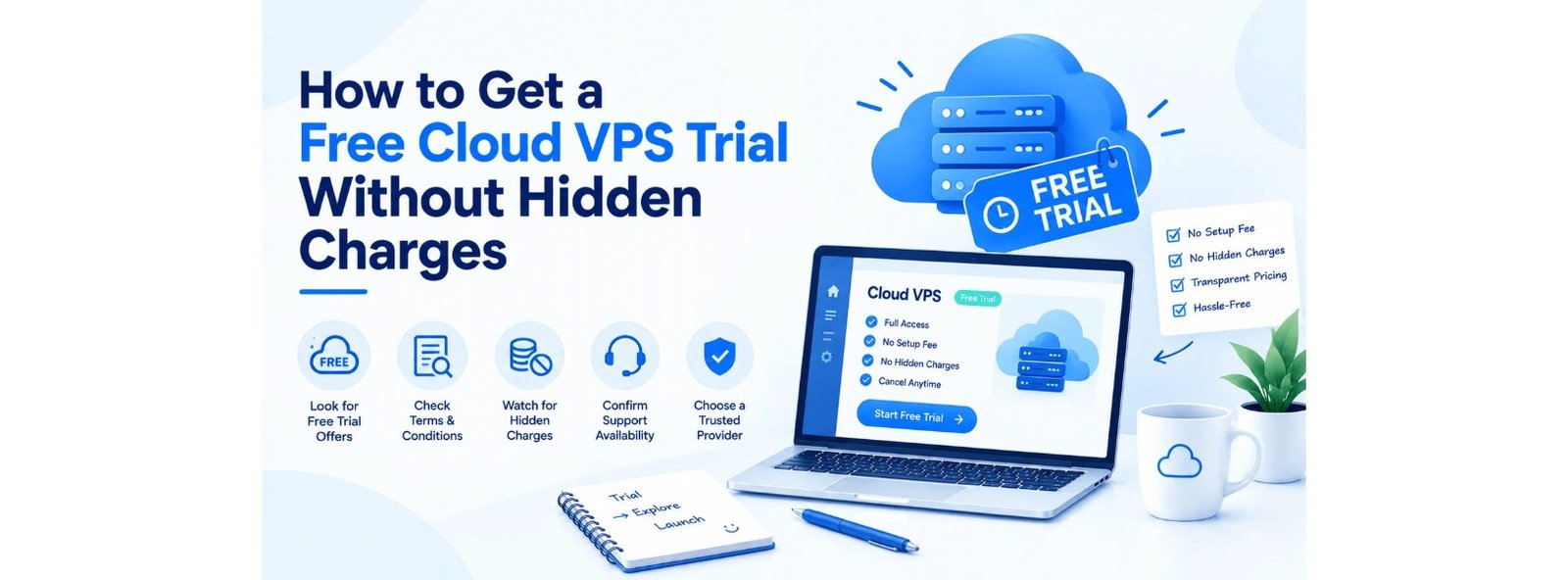
How to Get a Free Cloud VPS Trial Without Hidden Charges
Every developer testing new infrastructure wants clarity before commitment. A free cloud VPS trial without charges gives you exactly that: real server resources to explore, with no surprise deduction waiting at the end of the week. Signup pages promising instant access make it easy to miss what is hidden in the fine print, free usage limits, storage caps, bandwidth ceilings, and upgrade prompts, even for experienced developers. The right trial should function as a genuine test drive, not a countdown toward an unwanted subscription.
Cost alone does not tell the full story when picking a cloud VPS hosting server. Processing power, storage type, network speed, and support response time matter just as much once a project goes live. Many hosting brands promote trial periods heavily, then hide restrictions where new users are unlikely to look. This guide breaks down what a transparent trial should include and how to identify providers who deliver on their promise without hidden charges.
Why Trials Matter
A trial period exists to answer one question: does this infrastructure suit your workload? Running an application on unfamiliar hardware for a week reveals far more than any spec sheet ever could. Boot speed, dashboard clarity, and support response time all become clear within a few days of real use. Numbers on a comparison page rarely capture how a control panel feels to navigate during a stressful late-night deployment issue.
Skipping this step often leads to migration headaches months later. A server often looks flawless during a low-traffic trial run, yet slows down considerably the moment real traffic peaks. A test project with a handful of visitors often looks fast on any server, yet the same server might slow down considerably once hundreds of users arrive at once. Consider an online store that runs fine during a trial with a handful of daily visitors, then slows noticeably once a marketing campaign brings in real customers. Switching hosts mid-project rarely happens smoothly, and testing early removes that risk before it costs anything.
Spotting Hidden Costs
Hidden charges rarely appear as a single line item. Hidden costs typically take the form of an automatic renewal, an unexpected data transfer charge, or an add-on selected by default during checkout. A budget hosting plan advertised at a low headline price often ends up costing more than a premium plan once these extras stack up. A provider might advertise fourteen free days while activating billing on day ten through a pre-checked box.
Reading the cancellation policy carries equal weight. Some companies require a support ticket submitted several days before cancellation takes effect. Others apply an early termination charge even during what is advertised as a free trial, a detail worth checking before registration rather than discovering it afterward.
Checklist Before Signup
A brief checklist of confirmations prior to account creation can help avoid most billing surprises in the future. Five minutes spent here often saves an equal number of frustrating support calls later.
Storage and Bandwidth Limits
- Storage size specified in GB, not vague wording.
- Daily bandwidth reset or a single trial allowance
- Charges or throttling once the limit runs out
Support and Uptime Terms
- Written uptime guarantee, not a general promise
- Real response time, checked before signup
- Paid upgrade required for faster support
Comparing Provider Terms
Trial terms vary considerably between hosting providers, and the differences often go unnoticed until a project is already in progress. Two providers rarely structure a trial the same way. One might extend the window to thirty days while capping CPU cores at a single core; another grants full resources for just seven days. A team that selects based on actual project needs typically performs better than one swayed by a promotional headline.
Pricing pages sometimes list a starting rate that applies only after the trial ends and only under specific conditions such as annual prepayment. A rate advertised at four dollars a month often doubles once a shorter billing cycle applies. Checking the standard monthly rate, not the discounted entry price, gives a realistic picture of long-term cost before signing anything.
Making Trial Count
Once access is active, treat the trial period as real production testing rather than casual browsing. Deploy an actual project, monitor resource usage, and note response times during peak hours. Three days of real activity teaches more than a month of idle exploration ever would, mainly because idle servers never reveal how they handle pressure.
A Cloudscene survey revealed that nearly 62 percent of businesses switch providers within their first year due to rushed or entirely skipped early testing. That figure reflects a pattern seen across small teams and larger companies alike: the decision made in week one often shapes hosting costs for years afterward. MilesWeb designed its trial to prevent that outcome, allowing new users ample time to assess performance before any payment is required.
Concluding Insights
A transparent trial reveals almost everything about a provider’s honesty. Companies confident in their infrastructure rarely need to hide terms behind fine print or auto-renewing plans. The ones worth trusting explain their limits upfront and let performance make the case on its merits.
MilesWeb includes free professional email accounts and daily backups with its trial. Both become useful as soon as a project moves past initial testing. A provider that states its terms clearly from the outset earns trust that lasts well beyond the trial itself. That kind of confidence is precisely what turns a short test run into a hosting relationship worth keeping for years.