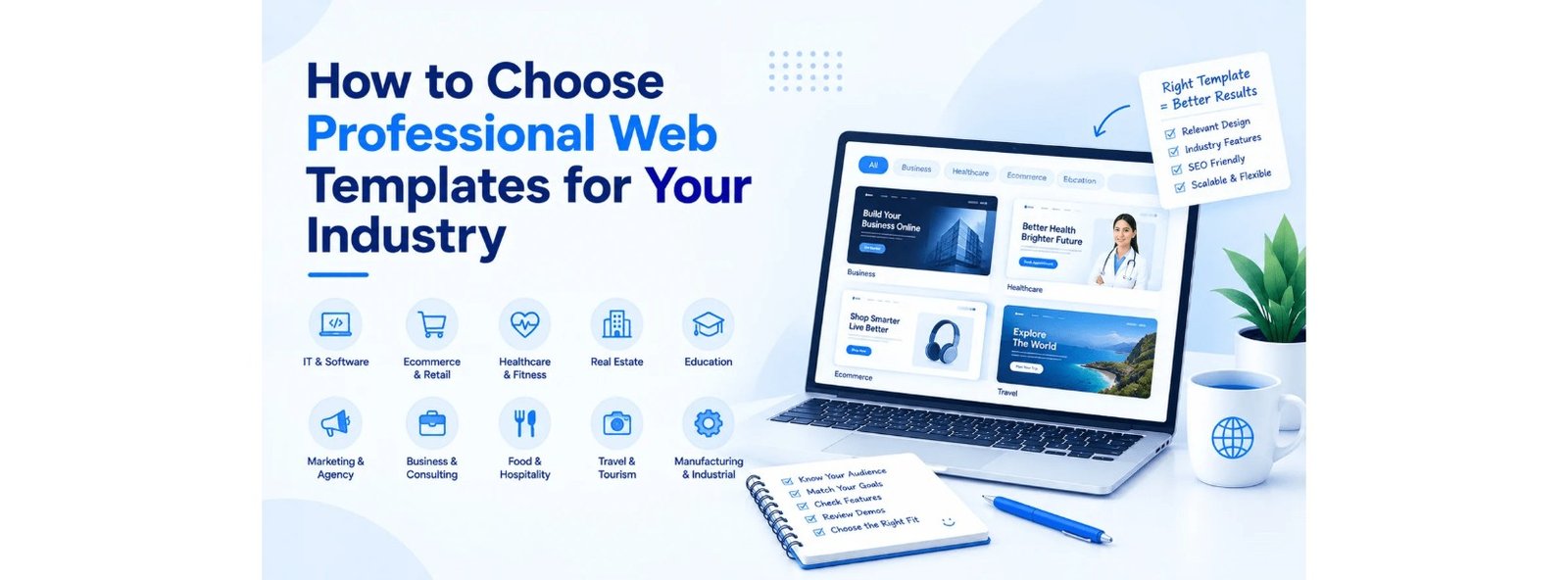
How to Choose Professional Web Templates for Your Industry
The template of a website can influence the outlook of potential customers regarding the business in the first few seconds. However, opting for industry-specific professional web templates isn’t only about choosing a visually appealing layout. A template must also meet the demands of the industry you are involved in, supporting the goals of your business, working efficiently on various gadgets, and allowing potential customers to find the needed information easily.
No matter whether you are looking for website for a restaurant, real estate website template, consulting company templates, or tech company websites, a correctly picked template can minimize the amount of work needed for development, saving you time. Here are some recommendations on how to select the right one according to your industry and business solutions.
Determine your niche requirements
The demands from various industries differ from each other. Thus, a restaurant is likely to have a menu, reservation options, and information on location and food pictures, while a law firm needs to have pages about the services provided, attorney information, and details about cases and forms for consultation.
To begin with, you need to recognize the essential details that visitors want on your webpage. This category helps you to choose your template more proudly rather than relying on the template’s color, fonts, or homepage.
For example, it is important for an e-commerce template to provide clear product presentation, category navigation, search, and important shopping actions. A professional website needs several matching templates with different structured service pages, testimonials, contact forms, and appointment features.
Audience-focused design
The appropriate template must be the one that fits the expectations of the target audience. This does not mean that all online websites in the industry must look the same. The idea is to choose the template with the proper visual style.
Look past appearances and images. Look at the navigation, spacing, font type, content structure, buttons, and page design. All of these factors will help determine whether the website looks professional and user-friendly.
Test mobile compatibility
A template that looks great on a desktop can be a bad experience on smartphones. This problem results in usability issues and difficulty in finding useful information. Look for templates that change their layout to fit different screens. Test how their menu, images, forms, buttons, tables, or text look on smaller screens.
Do not just rely on the template’s demo. You should test all important pages on various screen sizes. Pay close attention to navigation and conversion elements, like your contact forms, booking buttons, product descriptions, calls to action, and so on.
Test speed and performance
If too many scripts, heavy images, complex animations, or features are present in the template, the professional design will automatically be slow. Make sure you find a lightweight template with clean coding and minimal dependencies. Don’t go for the template just because it has numerous visual effects.
Performance also matters along with the host of your server, image processing, content caching, and other configurations. A well-designed template gives you a better starting point, but it does not guarantee excellent performance by itself.
Explore customization options
Your website has to resemble your company and not look like any other site using the same template.
Before you choose a specific template, find out how easy it is to change the typography, colors, structure, header and footer design, buttons, and images on that template. Additionally, make sure you can implement the features specific to your branch in the future.
For instance, a real estate compound will definitely need a property catalogue soon, whereas an online educational institution will need special pages and student features on its website.
Opt for flexibility rather than unnecessary characteristics. The best template is often the simple one that you can easily customize according to your needs.
Check SEO and accessibility
The template affects the way people interact with your site and how robots recognize it. Always look for a good structure, logical headings, proper content for crawling, sufficient navigation, and image optimization.
Do not forget about accessibility while making your choice. The text should be contrasting, buttons should be clear, forms should work properly, and navigation should remain the same on all devices.
Don’t think that an “SEO-friendly” template will instantly help you perform impressively in search engines. SEO depends on your content, technical difficulties, the website’s internal linking options, its performance, and its hosting.
Consider long-term support
Choosing a template is merely the first step of the web design process. Websites need to be updated because of changes in browsers, plugins, frameworks, and security requirements.
Prior to selecting a template, it is worthwhile to check how recently it has been updated, whether the developer provides any documentation, how frequently updates are released, and whether there is customer service support that is available. Confirm that any plug-ins or particular website builders being used together with your chosen template are still being supported. A visually appealing template can still run into problems later on if it is not being maintained.
Verify business needs
A good professional web template may not always be the most visually appealing, but it should effectively help customers achieve their website’s goals and fulfill its purpose.
If your business aims at lead generation, you should look for templates with clear sections about services provided, forms of contact, testimonials, and calls to action. If your aim is selling products, focus on templates that provide excellent product display, search options, and a simple purchasing process.
In case your site is considered to build a good reputation, develop good templates that provide additional information about the company, examples of its work, a portfolio, and customer reviews. Just ask yourself: does this template help my clients understand what I am doing?
Concluding Remarks
When it comes to finding a professional website template, you need to do much more than focus on the visuals alone. Some of the things you will need to keep in mind include your specific industry needs, customer expectations, usability on mobile devices, functionality, customizability, SEO, accessibility, and the cost of maintenance in the future.
You should start with the goals of your business and the needs of your customers and assess the template in light of those needs. A good template must offer you a solid basis without forcing you to adjust your business to fit in with its limitations.